Find the actual promise
Is it official, current and specific? Find the source—not the reaction—and write the proposed action in one plain sentence.
A field guide for election season
Examine political promises without surrendering your judgment.
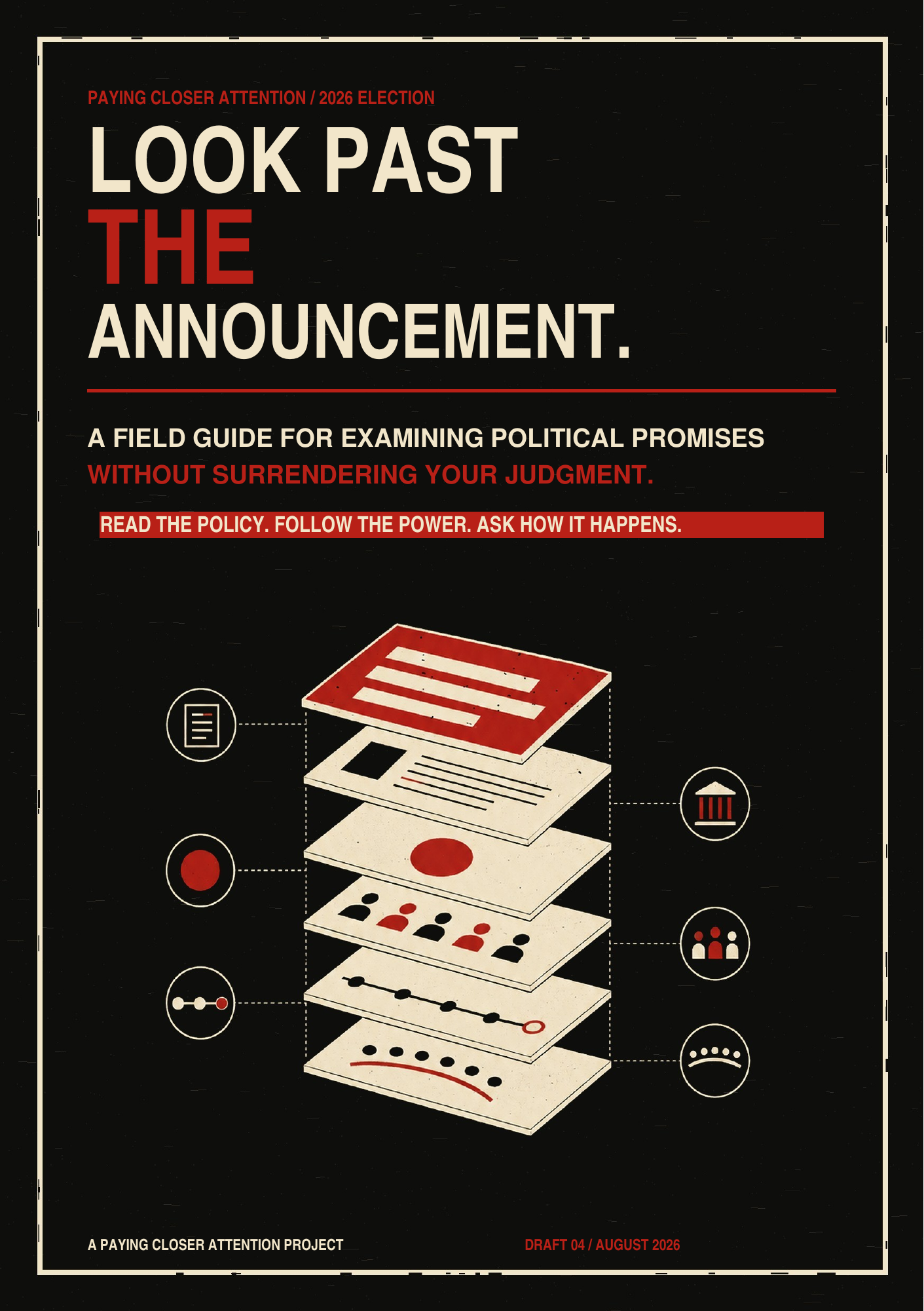
Start paying closer attentionRead the policy. Follow the power. Ask how it happens.
An invitation to slow down
Election campaigns move quickly. Headlines compress complicated choices into a contest of certainty, personality and momentum. The pressure is to react before we have had time to understand.
Paying Closer Attention begins somewhere else: with the willingness to pause, find the actual proposal and ask what it would change in the world.
This guide will not tell you who to vote for. It will help you examine what political parties are asking you to believe.
Use the same questions across parties
Slow enough to notice.
Simple enough to use.
Is it official, current and specific? Find the source—not the reaction—and write the proposed action in one plain sentence.
What cause does the policy assume? Does the diagnosis reach beneath the symptom, and what evidence supports it?
Who gains influence, choice or security? Who carries the cost, and what might be hidden or shifted elsewhere?
Is this an idea, a designed policy, or an implementation plan? Look for funding, timing, responsibility and transition.
What evidence is missing, why does it matter, and what would change your mind? Withholding judgment is allowed.
Find the actual promise
A value is not a mechanism. A policy is not automatically an implementation plan.
Name the problem
Follow the consequences
A benefit here can become a hidden cost somewhere else—or for someone later.
A promise is not yet a plan
These stages describe what is available to assess. They are not a score for whether you agree.
A desired outcome, principle or direction.
The mechanism, rules and important details are described.
Funding, timing, responsibility and transition are explained.
The approach has been implemented and there is evidence about how it performs.
Contained, substantial or system-wide? How many laws, institutions, skills, technologies and relationships must change together?
Complexity is not a weakness. It creates dependencies that should be named.
Robustness, not just efficiency
An efficient system can look convincing under ideal conditions. Robustness asks how it behaves when conditions change.
Robustness does not require perfect prediction. It asks whether the policy leaves room to adapt.
Use on any party, any issue
Start with the policy or announcement title, party, official source and date. Then work through these prompts without rushing to a verdict.
What is the actual promise?
What problem does it name?
Who gains power, choice or security—and who carries the costs?
What does delivery depend on?
How developed is it: an idea, a designed policy, a delivery plan, or evidence in practice?
What is the biggest unknown?
What is the one question you would ask?
What is your present judgment—and how confident are you?
Unknown is not the same as zero. Record the gap, say why it matters, and withhold judgment where the evidence cannot carry it.
Closer attention is not passive
Verify the source. Separate what the evidence says from what you think it means.
Ask what the other person sees. Name uncertainty without turning it into defeat.
Ask one precise question about mechanism, implementation or missing evidence—and request the source.
Compare parties on the same issue. Notice trade-offs, delivery capacity and what remains unknown.